Mathematical Investigation – Student Guide
What is CBA 1?
Classroom-Based Assessment 1 is a Mathematical Investigation. You will explore a mathematical question or idea and present your work as a report. This report may be presented in a wide range of formats (written, digital, visual, or a combination).
When will I do it?
You will complete CBA 1 over a three-week period during class time, usually towards the end of second year.
What will I be doing?
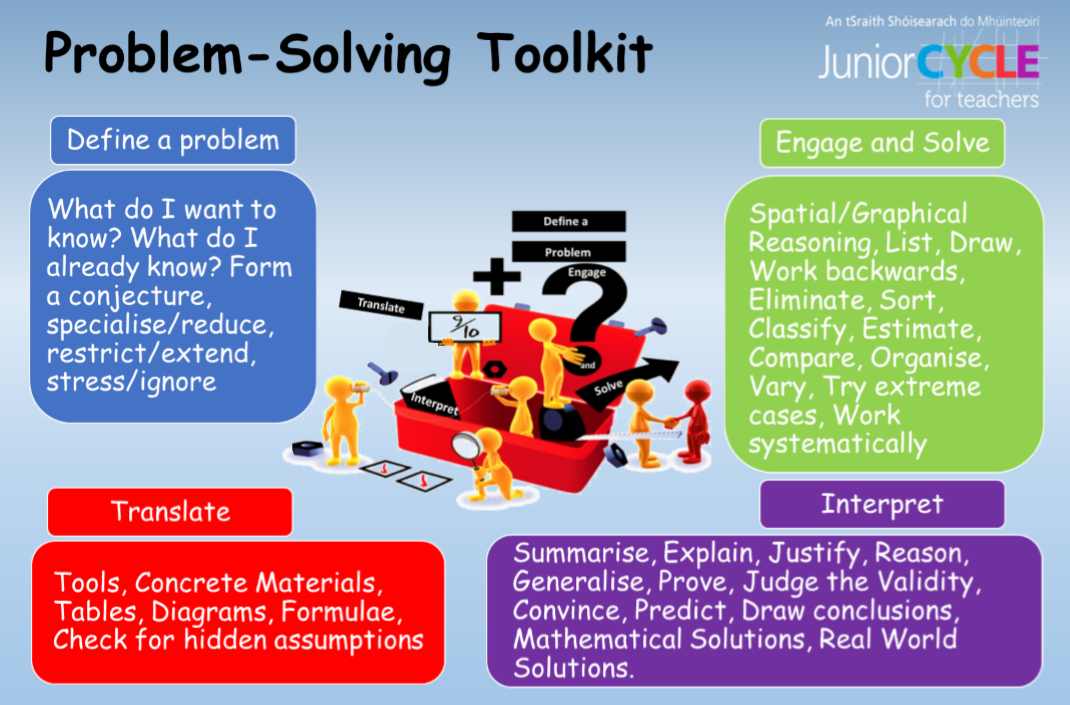
During the three weeks you will follow a problem-solving cycle to investigate your chosen mathematical problem.
The problem-solving cycle
- Define the problem – be clear about the question you are trying to answer.
- Break it into manageable parts – decompose the problem and/or simplify it using sensible assumptions.
- Translate to mathematics – represent the situation using numbers, diagrams, graphs, algebra, or other mathematical tools.
- Engage with the problem – try different strategies, explore patterns, and work towards a solution.
- Solve it if possible – some problems will have a full solution, others may only be partly solved.
- Interpret your findings – explain what your results mean in the context of the original problem.
What will I submit?
At the end of the three weeks you will submit your report, showing:
- the problem you investigated;
- the steps you took in the problem-solving cycle;
- the mathematics you used;
- your results and what you learned.
Planning a Mathematical Investigation of Exceptional Quality
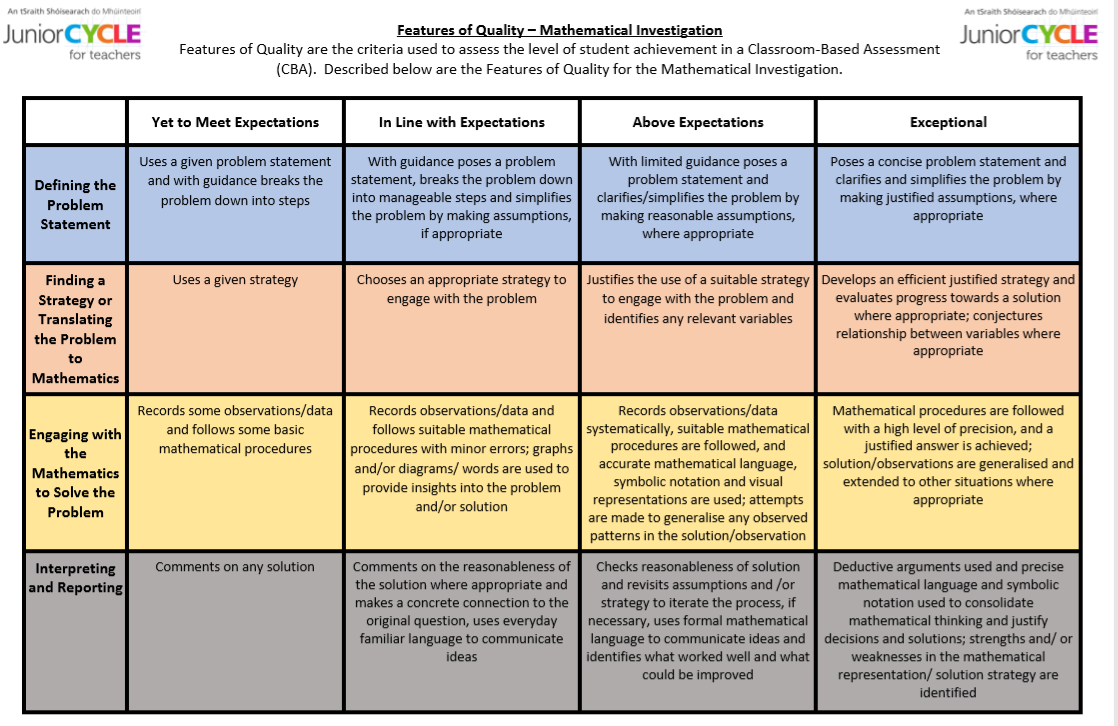
Use these questions to plan and reflect on your Mathematical Investigation. If you can answer most of them clearly, you are working at an exceptional level.
1. Defining the Problem Clearly
- What exact question am I trying to answer?
- Can I rewrite the problem as one clear, short statement?
- What information is missing or could be simplified?
- What assumptions am I making, and why are they reasonable?
- How do these assumptions help me to tackle the problem?
2. Choosing and Justifying a Strategy
- What different strategies could I use (tables, graphs, algebra, diagrams, patterns)?
- Which strategy seems most efficient and why?
- What are the important variables in this problem?
- Can I make a conjecture about how these variables are related?
- How will I check, as I work, that my strategy is helping me make progress?
3. Engaging with the Mathematics
- Have I carried out my calculations and procedures carefully and accurately?
- Have I clearly explained why I chose each method or representation?
- Am I using correct mathematical language and notation throughout?
- Do my tables, diagrams or graphs really help to answer the question?
- Can I see any patterns in my results, and can I generalise them?
4. Interpreting and Reporting
- What does my answer mean in the context of the original problem?
- Is my solution reasonable? How can I justify this?
- Have I used clear, logical arguments to support my conclusions?
- What worked well in my strategy and what were its weaknesses?
- If I repeated this investigation, what would I change or improve?
Sample CBAs
Bedroom Makeover
Sample judged In Line With Expectations

Cheetah enclosure?
Sample judged Above Expectations
Dog Walk
Sample judged In Line with Expectations
Locker Routes
Sample judged In Line With Expectations
Making Doughnuts
Sample judged In Line with Expectations
Parking Investigation
Sample judged In Line With Expectations