OnlineMaths.org
  • Home
    • Sample First Year Exam
    • Second Year Sample Test
    • JC Exam Papers
    • Revision Notes
    • Glossary
    • Unifying Strand
    • CBA1
    • Quizzes >
      • Pythagoras
      • Order of Operations
      • Compound Interest
      • Quiz images
      • Tossing Coins
      • Rolling Dice
      • Probability: Rolling 2 Die
      • 2-Step Equations
      • 3 Step Equations
      • Quadratic Coefficients
      • Quadratic Equations
      • Graphs of Quadratic Functions
      • Quadratic Formula
      • Slope of Lines
      • Slope from Equation
      • Perpendicular slopes
      • Linear Graphs
      • Arithmetic Sequences
      • Quadratic Sequences
      • Multiplying Fractions
      • Expanding Binomials
      • Expanding
      • Dividing a quadratic by a cubic
      • Division: Cubic by a linear
      • Division: Cubic by Quadratic
      • Squaring Binomials
      • Area
      • Median
      • Statistical Range
      • The Mean
      • The Mode
      • Mean of a FDT
      • Mean of a Grouped FDT
      • Stemplot: Median
      • Stemplot: Mode
      • Rounding
      • Adding integers
      • Integer Multiplication and Division
      • Fractions
      • Indices Laws
      • Indices - Roots
      • Significant Figures
      • Fractions Raised by Powers
  • Number
    • Natural Numbers & Integers
    • Indices
    • Rounding
    • Fractions, Decimals & Percentages
    • Sets
    • Arithmetic and Money
  • Geometry
    • Perimeter, Area & Volume
    • Constructions
    • Coordinate Geometry
    • Geometry
    • Trigonometry
  • Stats & Probability
    • Statistics
    • Probability
  • Algebra
    • Evaluate Expressions
    • Add, Subtract & Multiply
    • Solving Linear Equations
    • Algebra 1
    • Factorising
    • Quadratic Equations
    • Simultaneous Equations
    • Algebraic Fractions & Division
    • Rearranging Formulae
    • Solving Word Problems
    • Solving Inequalities
    • Functions
    • Graphing Functions

Indices 

Picture

Indices and Roots

Powers • Square Roots • Laws of Indices

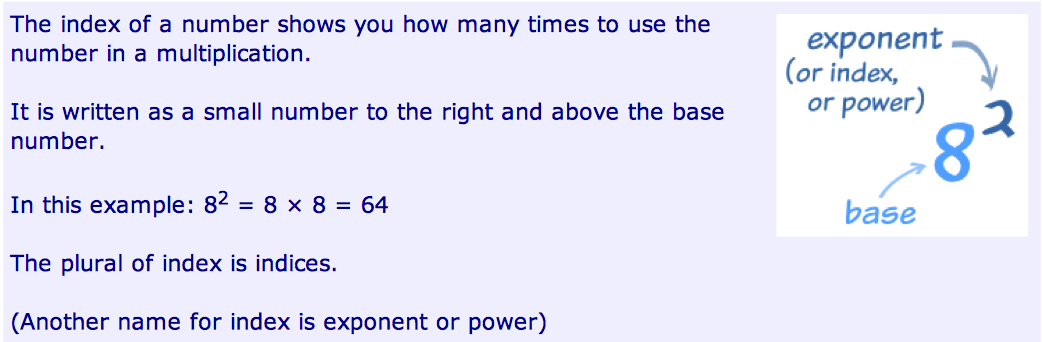
An index (or exponent) tells how many times a number is multiplied by itself. For example, 34 = 3 × 3 × 3 × 3 = 81.

A root is the inverse of an index. For example, the square root of 81 is √81 = 9.

In this topic you will explore powers, roots, and the rules that connect them — known as the Laws of Indices.

Indices

Roots and Indices

Squares and Square Roots Quiz

Question 1 of 5 Score: 0 / 5
© onlinemaths.org

Laws of Indices

Key rules & examples

Exponent of Zero

Rule: a0 = 1 (for any a ≠ 0).

A non-zero base raised to the power of zero is always 1.

Example: 50 = 1.

Exponent of One

Rule: a1 = a.

A base raised to the power of one is itself.

Example: 71 = 7.

Product of Powers

Rule: am × an = am + n.

When multiplying exponential terms with the same base, add the exponents.

Example: x2 × x3 = x2+3 = x5.

Quotient of Powers

Rule: (am) ÷ (an) = am − n (for a ≠ 0).

When dividing exponential terms with the same base, subtract the exponents.

Example: (y5) ÷ (y2) = y5−2 = y3.

Power of a Power

Rule: (am)n = amn.

When raising a power to another power, multiply the exponents.

Example: (x2)3 = x2 × 3 = x6.

Negative Exponent

Rule: a−n = 1/(an) (for a ≠ 0).

A negative exponent indicates the reciprocal of the base raised to the corresponding positive power.

Example: 2−3 = 1/(23) = 1/8.

Laws of Indices Quiz

Question 1 of 5 Score: 0 / 5
© onlinemaths.org

Scientific Notation

Powers of 10 • Very large & small numbers

Scientific notation is a way of writing very large or very small numbers using powers of 10. It helps us write numbers clearly and compare their size more easily.

In scientific notation a number is written in the form a × 10n, where 1 ≤ a < 10 and n is an integer.

For example:

  • 4 000 = 4 × 10³,
  • 50 000 = 5 × 10⁴,
  • 0.007 = 7 × 10⁻³,
  • 0.00032 = 3.2 × 10⁻⁴.

  • Index Form & Scientific Notation Quiz

    Question 1 of 5 Score: 0 / 5
    © onlinemaths.org

    Picture

    Scientific Notation


    Powered by Create your own unique website with customizable templates.