OnlineMaths.org
  • Home
    • Sample First Year Exam
    • Second Year Sample Test
    • JC Exam Papers
    • Revision Notes
    • Glossary
    • Unifying Strand
    • CBA1
    • Quizzes >
      • Pythagoras
      • Order of Operations
      • Compound Interest
      • Quiz images
      • Tossing Coins
      • Rolling Dice
      • Probability: Rolling 2 Die
      • 2-Step Equations
      • 3 Step Equations
      • Quadratic Coefficients
      • Quadratic Equations
      • Graphs of Quadratic Functions
      • Quadratic Formula
      • Slope of Lines
      • Slope from Equation
      • Perpendicular slopes
      • Linear Graphs
      • Arithmetic Sequences
      • Quadratic Sequences
      • Multiplying Fractions
      • Expanding Binomials
      • Expanding
      • Dividing a quadratic by a cubic
      • Division: Cubic by a linear
      • Division: Cubic by Quadratic
      • Squaring Binomials
      • Area
      • Median
      • Statistical Range
      • The Mean
      • The Mode
      • Mean of a FDT
      • Mean of a Grouped FDT
      • Stemplot: Median
      • Stemplot: Mode
      • Rounding
      • Adding integers
      • Integer Multiplication and Division
      • Fractions
      • Indices Laws
      • Indices - Roots
      • Significant Figures
      • Fractions Raised by Powers
  • Number
    • Natural Numbers & Integers
    • Indices
    • Rounding
    • Fractions, Decimals & Percentages
    • Sets
    • Arithmetic and Money
  • Geometry
    • Perimeter, Area & Volume
    • Constructions
    • Coordinate Geometry
    • Geometry
    • Trigonometry
  • Stats & Probability
    • Statistics
    • Probability
  • Algebra
    • Evaluate Expressions
    • Add, Subtract & Multiply
    • Solving Linear Equations
    • Algebra 1
    • Factorising
    • Quadratic Equations
    • Simultaneous Equations
    • Algebraic Fractions & Division
    • Rearranging Formulae
    • Solving Word Problems
    • Solving Inequalities
    • Functions
    • Graphing Functions

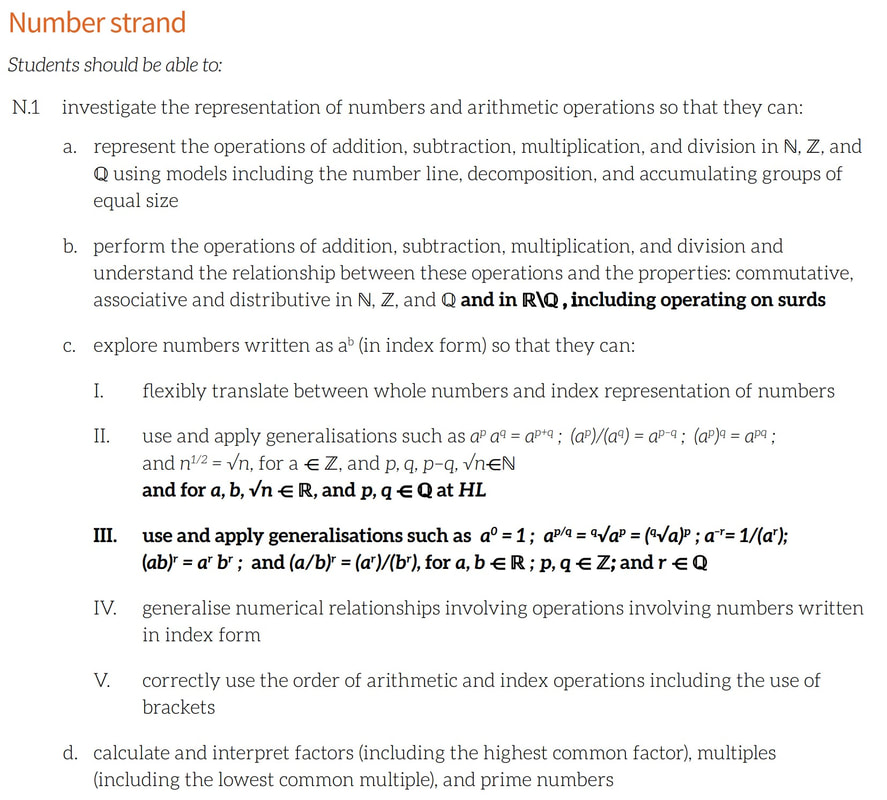
Number strand

Students should be able to:

N.1

Number representations and arithmetic operations

Operations and models

  • represent the operations of addition, subtraction, multiplication, and division in ℕ, ℤ, and ℚ using models such as the number line, decomposition, and accumulating equal groups.
  • perform the operations of addition, subtraction, multiplication, and division and understand the relationships between these operations and the properties commutative, associative, and distributive in ℕ, ℤ, ℚ and in ℝ\ℚ, including operating on surds.

Index notation and laws

  • work with numbers written in index form \(a^b\) and translate flexibly between whole numbers and index representations.
  • use and apply generalisations such as ap · aq = ap+q, ap/aq = ap−q, a0 = 1, and a1/n = √[n]{a}, for a ∈ ℤ and p, q, p−q, n ∈ ℕ; at HL, also for a, b, √n ∈ ℝ and p, q ∈ ℚ.
  • use and apply further generalisations such as a0 = 1, ap/q = √[q]{ap} = (√[q]{a})p, a−r = 1/ar, (ab)r = arbr, and (a/b)r = ar/br, for a, b ∈ ℝ, p, q ∈ ℤ, and r ∈ ℚ.
  • generalise numerical relationships involving operations on numbers written in index form.
  • use correctly the order of arithmetic and index operations, including the use of brackets.

Factors, multiples, and accuracy

  • calculate and interpret factors (including the highest common factor), multiples (including the lowest common multiple), and prime numbers.
  • present numerical answers to the specified degree of accuracy, for example: correct to the nearest hundred, to two decimal places, or to three significant figures.

Standard form

  • convert a number p ∈ ℚ in decimal form to the form a × 10ⁿ, where 1 ≤ a < 10, n ∈ ℤ, and p is either p ≥ 1 or 0 < p < 1.
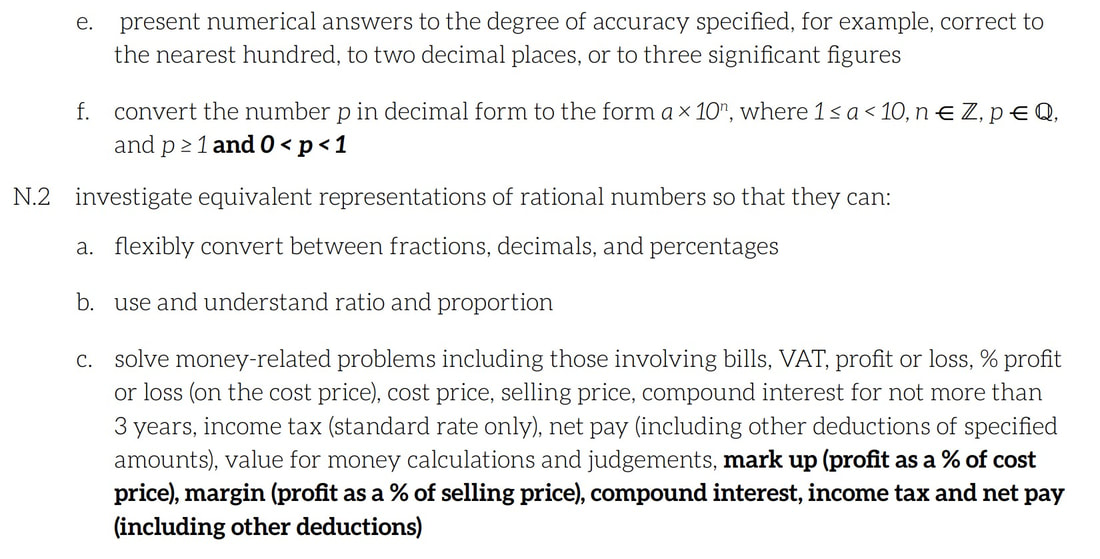
N.2

Rational numbers and money

Equivalent representations

  • convert flexibly between fractions, decimals, and percentages.
  • use and understand ratio and proportion.

Money-related problems

  • solve money-related problems including those involving bills, VAT, profit or loss, percentage profit or loss (on the cost price), cost price, selling price, compound interest for not more than three years, income tax (standard rate only), net pay (including other deductions of specified amounts), value for money calculations and judgements, mark up (profit as a % of cost price), margin (profit as a % of selling price), compound interest, income tax and net pay (including other deductions).
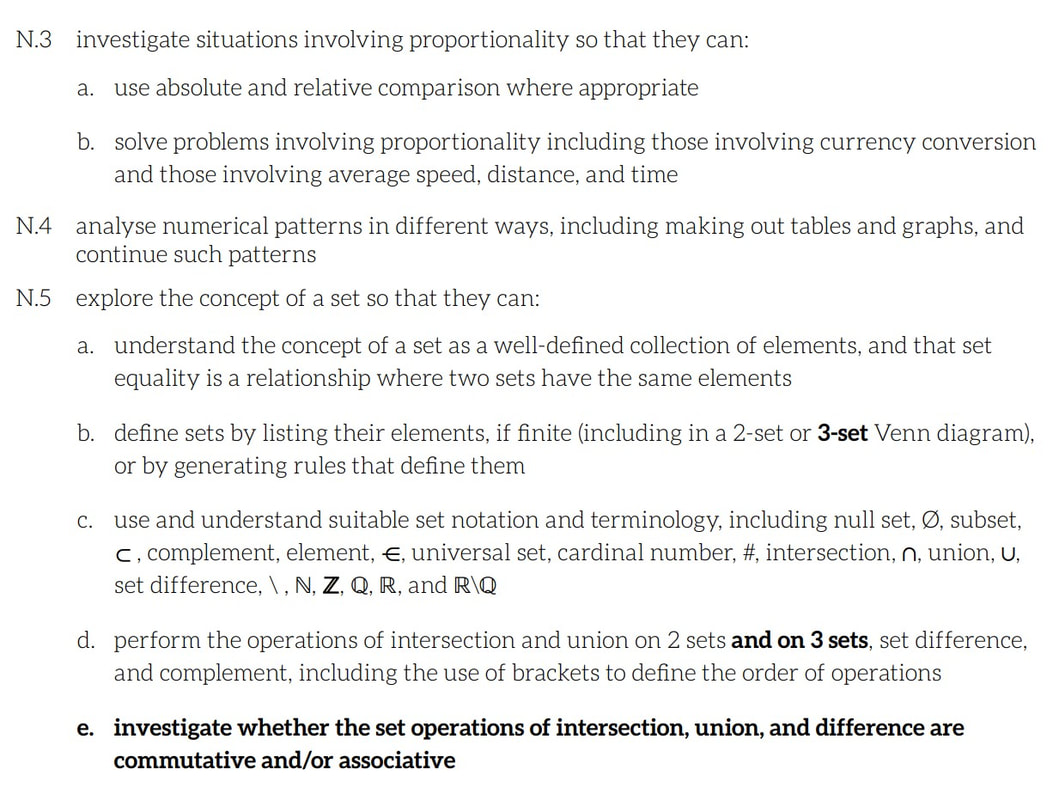
N.3

Proportionality

Comparisons and problem solving

  • use absolute and relative comparison where appropriate.
  • solve problems involving proportionality, including currency conversion and problems involving average speed, distance, and time.
N.4

Numerical patterns

  • analyse numerical patterns in different ways, including making tables and graphs, and continue such patterns.
N.5

Sets

Concept of a set

  • understand a set as a well-defined collection of elements, and that set equality means two sets have the same elements.

Describing sets

  • define sets by listing their elements if finite (including in 2-set or 3-set Venn diagrams), or by giving rules that define them.

Notation and terminology

  • use and understand notation and terminology including: null set, ∅, subset ⊂, complement, element ∈, universal set, cardinal number #, intersection ∩, union ∪, set difference \, and the number sets ℕ, ℤ, ℚ, ℝ, ℝ\ℚ.

Operations on sets

  • perform intersection and union on two sets and on three sets, set difference, and complement, including using brackets to define the order of operations.
  • investigate whether the operations of intersection, union, and difference are commutative and/or associative.
Powered by Create your own unique website with customizable templates.